

India’s benchmark Nifty 50 surged about 5% at Tuesday’s open after New Delhi and Washington announced a long-awaited trade deal that sharply reduces U.S. tariffs on Indian exports. The index later gave back a portion of the move but still traded solidly higher, putting it on track for its strongest single-session gain in years if momentum holds.
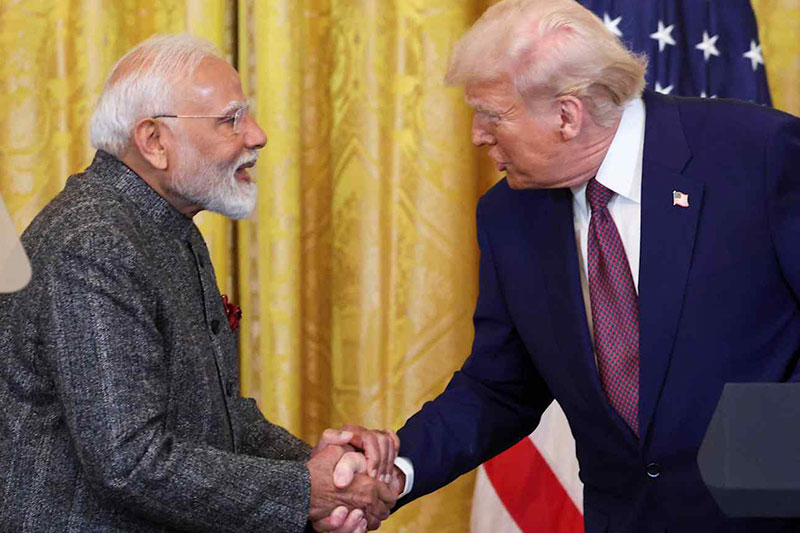
The catalyst was a new tariff framework outlined by Donald Trump, who said the United States would cut its reciprocal tariff on India to 18% from 25%. He also said India would reduce its tariff and non-tariff barriers on U.S. goods to zero, although the scope and implementation timeline were not fully detailed in the initial remarks.
The announcement followed a period of uncertainty around how U.S. tariffs on India would ultimately be structured. The U.S. had previously applied a 50% tariff in some categories, including an additional 25% duty on India’s purchases of Russian oil. Because the latest statement emphasized “reciprocal” tariffs, it created early confusion about whether the entire tariff stack was being removed or whether the new 18% rate effectively replaces prior measures. Subsequent reporting indicated that the overall tariff level is now set at 18%, but investors initially had to interpret incomplete signals.
A second headline element of the deal was energy. Trump said that, during his call with Narendra Modi, India agreed to stop buying Russian oil and instead increase purchases from the U.S. Modi, in a social-media post, said “made in India” products will face an 18% tariff rate in the U.S., and he framed the agreement as supportive of broader stability and prosperity goals.
Markets reacted swiftly because the tariff outcome was viewed as meaningfully better than many investors had expected, especially after months in which trade uncertainty weighed on sentiment. The move also arrives shortly after India concluded a separate trade agreement with the European Union, reinforcing the perception that the country is shoring up external demand channels for 2026.
The rally comes after a challenging period for Indian assets. Despite the Nifty posting gains of over 10% in local currency terms in 2025, performance looked weaker in U.S. dollar terms because the currency depreciated. Relative performance also lagged broader emerging-market benchmarks last year, with India underperforming amid foreign investor withdrawals and persistent macro uncertainty.
Currency markets responded as well. The Indian rupee strengthened about 1% after the deal, trading around 90.29 per dollar at the latest reading cited. A firmer rupee can help reduce imported inflation pressure, but it can also complicate export competitiveness at the margin, leaving policymakers and markets focused on how the new tariff regime ultimately influences trade volumes, investment flows, and earnings.
For now, the near-term signal is clear: investors are treating the deal as a relief event, lifting equities and stabilizing the currency after a period in which tariffs and outflows were a persistent overhang.